WCS Teachers

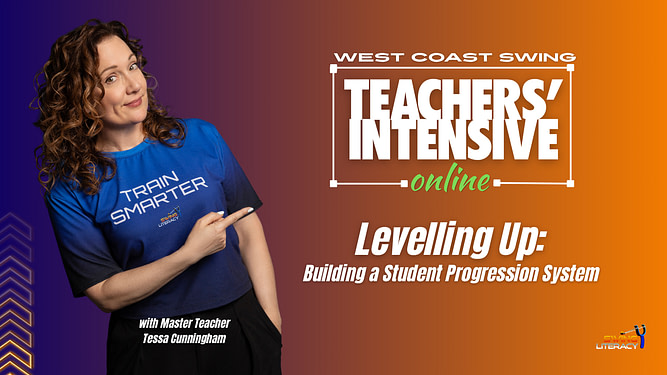
4-hour training session online
for experienced WCS teachers

with Master Teacher
Tessa Cunningham

Teachers' Intensive:
Levelling Up

Building a Student Progression SYSTEM

Create or renovate how you progress your students through your class levels so they keep motivated and build community

Why do some communities produce great dancers...

...while others have students stuck in the same level for years?


Every West Coast Swing Community has class levels:

Beginner - Intermediate - Advanced
(or whatever labels you prefer)

But very few communities have intentionally designed the architecture of what students should learn, when they should learn it, and how they'll know they're ready to move on.

Instead, most of us inherit a structure and keep teaching inside it - without really analyzing if it could be better.

As a result...

Students...

  • don't know what to work on
  • plateau
  • don't practice
  • move up too early
  • become frustrated
  • stop coming back

Teachers...

  • aren't sure where to draw the line
  • feel pressure to promote students
  • struggle teaching mixed-level classes
  • have inconsistent expectations
  • reinvent every class
  • struggle to fill classes

IT'S TRAINING DAY

Let's tackle these critical teaching issues together in a one-day teachers' intensive:

4 HOURS - ALL ONLINE

$197 USD

Registration includes workbooks and access to the recording for one year.

During this workshop

You'll begin designing or redesigning:

your student journey

strategies for mixed-level teaching

learning outcomes for each level

graduation criteria & assessment procedures

culture & motivation strategy

how to get students craving technique & practice

This intensive introduces the philosophy and framework behind student progression systems that work smarter for West Coast Swing.

Teachers who want to build a complete system tailored to their own community can continue the work inside the Teacher Development Program.

Here are just a few success stories from teachers who tried this method...

Paul Diffendaffer

10/10 Highly recommended!

10/10 Highly recommended! The course material is highly relevant, intelligently sequenced, and will lead to rapid improvements in the quality of your dance. The progressive skill building nature of this course makes progress easy and long lasting.

Greg Van Wijk

I owe it to my students

Learning how best to convey these concepts to students was golden. The assignments were very demanding as you actually have to apply what you learned instead of simply regurgitate it. I’d recommend this to anyone wanting to teach WCS and give your students the best possible chance of coming out of the series with solid fundamentals that make sense no matter what direction WCS takes down the road. If I only had access to these concepts back when first I started I wouldn’t be in the position of having to retrain my body to unlearn years of reinforced bad habits. I feel I owe it to my students to give them the best available information and convey it in the most understandable way I can. I strongly recommend this course.

Sheri Courtney

Superpower for dancing with Beginners

Last week a young man, who had participated in the beginner class sat off to the side intently watching as the social dance began. I could see that he was literally “drinking it all in”!
When I heard a song with a simple clear beat come on I asked him if he would like to dance.
He was nervous & concentrating SO hard while using the “step back lead and step out of the slot” techniques he learned in class. But then he began to relax, then smile- then break out in a big grin!

This is where having Swing Literacy training and insight led to ME having MY BEST dance of the evening!
Because this young man was “on top of the world” & had a complete change of demeanor at his success.
His eyes shone and he began to talk to others sitting near him.
What a treasure it is to share someone's first real social dance.

Linda Degutis

Swing Clubs investing in their teachers

Two WCS dance groups in the Atlanta area have had their instructors (and some of the practice assistants) take the Swing Literacy Teacher Training. I know for certain that one of the clubs paid for their teachers to take the training. As a result of this, there is a notable difference between the teaching styles and methods of the teachers who have taken the training and teachers (primarily teaching for other groups) who have not (and notable difference in the improvement of their students).

In addition, the training has changed the approach to beginner lessons, and progression through the beginner series. Both the students and the teachers have benefitted from this Swing Literacy Teacher Training. And, the teachers are able to use the training when they teach private lessons, so it is another benefit to them. -Linda DeGutis

Glenn Clark

Observing a Swing Literacy newcomers workshop

"I recently had the privilege to assist in large back-to-back newcomer (brand new to WCS) workshops. The first workshop employed the Swing Literacy teaching method, and the next workshop used the more traditional method. Having studied both methods, I expected the Swing Literacy method to work better, but I was not prepared for just how effective it was and how quickly it worked.

During the Swing Literacy segment of the newcomers’ workshop, I noticed the students were able to perform many of the skills to a level I would typically expect from more experienced dancers. Dancing with newcomers and being able to feel their elasticity and having them connect to me like an intermediate dancer was definitely a surprising experience: t was easy and enjoyable - it wasn't a chore or struggle to dance with them. I observed them smiling, laughing, keeping their eyes up, and focusing on their partners. After the workshop was over, I was impressed that they were able to sustain these skills as they practiced on their own.

The traditional-method workshop was taught by very experienced and lovable teachers, but about 10 minutes in, the atmosphere in the room changed. I noticed that the students started struggling: the usual frustrations that go along with learning dance for the first time were back. I had one couple ask me for help with the patterns that were being taught, and the leader refused to dance until he could figure out his own steps. At this point he was so frustrated that no matter what I did, whether breaking down the pattern or asking him to ignore the pattern and just dance had no effect. He was already too stressed out to dance or learn at this point: a common problem that I have seen in many classes.

When I danced with the Newcomers in the traditional workshop, many of their skills that made our dances enjoyable for me during the Swing Literacy workshop had disappeared: they stopped their momentum, they stopped using elasticity, their heads were down, looking at their own feet, and they were all focused on trying to do the patterns instead of leading or following.

As someone who has both danced and taught WCS for years I found myself a little confused during the traditional method workshop - I can only wonder how much the Newcomers must have been struggling at that point. From my personal experience during these workshops I would definitely say that the Swing Literacy method taught WCS in a way that newcomers could easily understand and allowed them to not only progress faster but also to enjoy their experience far more than the traditional method of teaching." -Glenn Clark
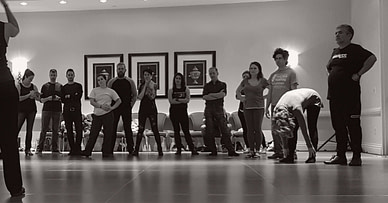
Joan Izumigawa

Connects all the loose ends from multiple teachers

This is different from any other learning format, and is an opportunity to be exposed to a new way of learning WCS. It is strategic and very well communicated. It keeps you motivated and accountable. It also provides you a sense of Community with others that are like minded. SL is different in that it starts with the foundation and builds from there, as opposed to my past experience, where a multitude of teachers and lessons were constructing a dancer with spackle. Takes all the loose ends from multiple teachers and weaves them into a comprehensive approach that supports the learning process.

Jeremy Reuben

Courage to step out of the box

I had a gut feeling that things should be taught a different way - Swing Literacy gave me the courage to step out of the box of the old school teaching methodology. It gave me affirmation, guidance, courage, valildation. It reinforced my dedication to the concept of drills & skills over patterns & footwork, and I realized what was critical both to focus on and to avoid focusing on.

Tairra Sitek

Juicy details about "how" and "why"

I highly recommend the Swing Literacy program for anyone who would like to understand the mechanics of WCS. The pedagogical approach is highly effective as the content and drills build on each other and you'll see results quickly. The program gives you the language to articulate yourself more clearly in class to ask better questions as well as all of the juicy detail you always wanted to know about the "why" and the "how" it works.

Miranda Lam

First time trying Swing Literacy with a newcomers workshop

First of all it was a lot of fun for me teaching the class with a different approach than how I learned to dance WCS myself a few years ago. There was more interaction with the students than I’ve seen at other beginner classes.

(The recommended drills and sequence)... were not only a lot of fun but also worked great... in no time it looked like they were dancing West Coast Swing even though it was a simpler version. Everyone was on time, followers waited to be led, and they found it easier to pick up new patterns. Nobody looked at their feet, not once! I danced with the followers and really loved their connection, it really felt like a WCS connection already.

The group was small, but definitely not everybody extremely talented, and still everybody seemed to be able to dance WCS passes that look and feel like WCS within an hour. Definitely will use more of this concept for my next beginner workshop :-) - Miranda Lam

Cecile Terillon

Guided Independence

“What I love about lessons with Tessa is her really interesting way of teaching. She never says : “Stop thinking, just do this shape like that because I told you to”. Instead, she takes the time to ask you the right questions to guide you to think for YOURSELF about your dance. This self-analysis makes me understand my own body mechanics, and learn even faster! Now every time I leave the ballroom, it’s always with a big smile because I had a lot of fun and also because I discovered something new about my way of dancing. It’s always like a revelation.”

Matt Davis

Way better than "winging it"!

I felt like this program gave me a very solid way to break down concepts, and gave me a solid sequence which is easy to stick to in each lesson.  This also helped increase my confidence as a teacher a lot, because I used to just try to "wing it" and teach based on what I saw, and this program helped me have a good idea for what elements I should be teaching right away.  It also encouraged me not to shy away from more advanced concepts for beginners, which I felt like has allowed me to teach better, keep students interest better, and produce students that are doing the dance better.

Brendan Souvenir

Delivering missing critical skills

I feel as though in other intensives, instructors will demonstrate patterns and strategies, but will not connect these to the basic skills that are required to perform these patterns/strategies. Myles and Tessa do a fantastic job explaining what prerequisite skills are required to compete the task at hand, and that helps people catch onto the material SO MUCH quicker.

We have a huge class of dancers (especially leaders) who are missing critical skills in their dance, trying to perform patterns and strategies in which they don't have the underlying/supporting skills for. Swing Literacy focuses specifically on filling those gaps in dancers' skill base. I definitely attribute MUCH of my success to your teaching style of skills before patterns.

Jessica Wrape

Transformed my community

I loved it. I thought the way it was presented and how it flowed was good for how I learn. I think it took me longer to complete because I would read articles and then mull over them and try to think how that worked or changed the way I would teach. It was very rewarding to me and my students did notice the change overnight. It’s helped me learn to engage my students more and organize my thoughts with a more natural progression for the dance. I get so tired of lecture type teaching with zero questions. I want my students to think more for themselves and know earlier about the hows and whys.

B Tarbell

Best teaching method I've ever experienced

Best teaching method I've ever experienced (and I've completed 22 years of formal schooling!) It's like having the reference book on everything WCS PLUS the physical drills, feedback and supportive learning community! 

Lily Harned

Gave my instincts a logical structure

Up until this course, I had a mish-mash of information and concepts drawn from various teachers and from my own experience, but I didn't have a logical, consistent structure to provide a framework for it all. This is absolutely going to me give me more confidence (much needed), as now I feel like I know what I'm talking about.

This is perfect for...

  • Experienced teachers seeking professional development and wanting to sharpen their tools
  • Newer teachers needing education and trying to establish a smart system
  • Small communities trying to establish a more solid structure
  • Studios looking to update and upgrade their processes to improve their output

Imagine...

  • Students understand exactly what they're working toward.
  • Teachers all use the same language.
  • Students feel proud when they graduate.
  • Technique isn't something students resist.
  • Moving students between levels is straightforward.
  • Your classes build on each other instead of feeling disconnected.
  • Your community develops stronger dancers year after year.

Get registered

and kickstart your new season with an upgrade

Copyright © 2026 - SwingLiteracy.com

>